
14 October 2026 · Ultracore Team
URL Encoding Explained: encodeURIComponent vs encodeURI
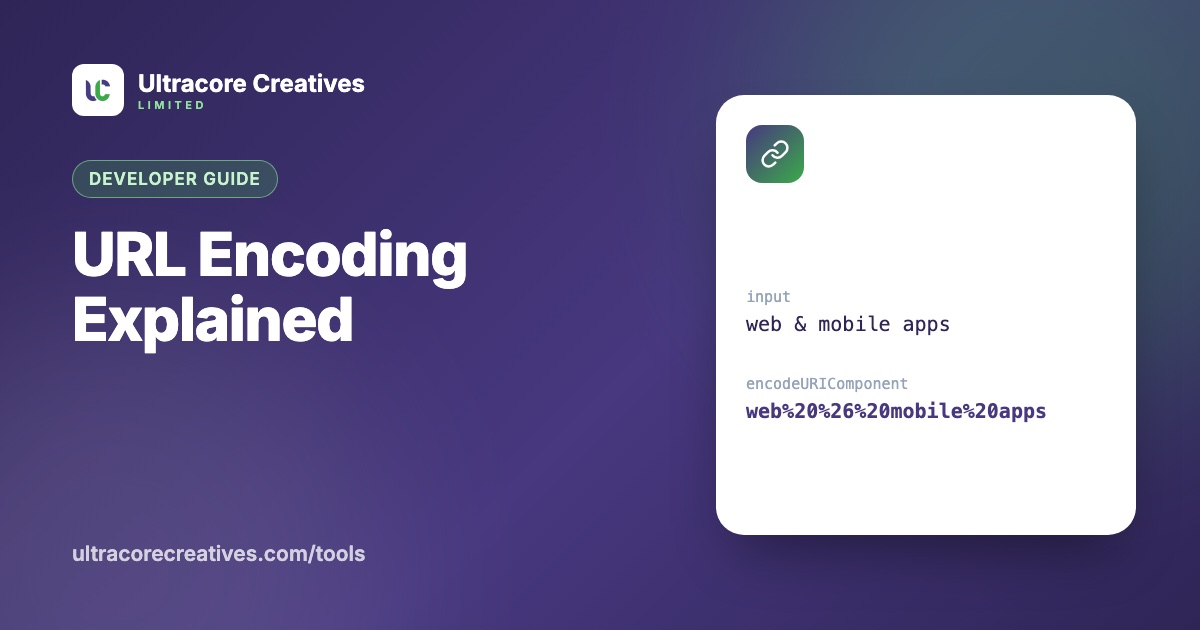
URLs can only contain a limited set of characters. Letters, digits and a few symbols are safe, but characters like spaces, &, ?, # and anything outside basic ASCII must be encoded before they go into a URL. Get it wrong and a search for “web & mobile” turns into a search for “web ”, or a link breaks halfway through.
How percent-encoding works
URL encoding (officially “percent-encoding”) replaces each unsafe character with a % followed by two hexadecimal digits for each of its bytes in UTF-8:
- Space →
%20 &→%26/→%2Fé→%C3%A9(two bytes in UTF-8)👋→%F0%9F%91%8B(four bytes)
Some characters are reserved because they have a job in the URL’s structure: ? starts the query string, & separates parameters, = separates names from values and # starts the fragment. If your data contains them, they must be encoded so they aren’t mistaken for structure.
encodeURIComponent vs encodeURI
JavaScript has two built-in functions, and choosing the wrong one is the most common mistake.
encodeURIComponent encodes everything except letters, digits and - _ . ! ~ * ' ( ). Use it for individual pieces, such as a single query value:
const q = 'web & mobile apps';
const url = `https://example.com/search?q=${encodeURIComponent(q)}`;
// https://example.com/search?q=web%20%26%20mobile%20apps
encodeURI leaves the structural characters (: / ? & = #) alone. Use it only to clean up a complete URL that might contain spaces or non-ASCII characters:
encodeURI('https://example.com/über uns?page=1');
// https://example.com/%C3%BCber%20uns?page=1
If you used encodeURI on the search value above, the & would stay unencoded and the server would see two parameters instead of one.
Spaces: %20 or +?
Both appear in the wild. In URL paths, a space must be %20. In HTML form submissions and many query strings (the application/x-www-form-urlencoded format), spaces are sent as +. That’s why decodeURIComponent alone won’t turn + back into spaces: you have to replace them first. Our URL Encoder / Decoder has a “Treat + as a space” option for exactly this.
Common URL encoding bugs
- Double encoding: encoding a value that was already encoded turns
%20into%2520. If you see%25in your URLs, something is encoding twice. - Not encoding at all: building URLs with string concatenation works fine in testing, then breaks when a real user types an
&or#. - Decoding malformed input: a stray
%that isn’t followed by two hex digits makesdecodeURIComponentthrow an error. Wrap it intry/catchwhen the input comes from users. - Encoding the whole URL as a component:
encodeURIComponent("https://…")also encodes:and/, which is right when the URL is *itself* a parameter value (like a redirect target), but wrong for the URL you’re navigating to.
Encoding in other languages
- Python:
urllib.parse.quote(value, safe="")for components,urllib.parse.urlencode(dict)for query strings - PHP:
rawurlencode()(spaces as%20) orurlencode()(spaces as+) - Java:
URLEncoder.encode(value, StandardCharsets.UTF_8)(uses+for spaces)
To quickly check what a value encodes to, or to read an encoded URL from a log file, paste it into the free URL Encoder / Decoder. It runs entirely in your browser.
Have a project in mind? Let’s talk it through.
A free, no-commitment call to understand what you’re building and how we can help.